
CHLOË RENERS: AN IN-DEPTH INTERVIEW
Belgian designer Chloë Reners, fresh out of the Royal Academy of Fine Arts in Antwerp and now part of the Dior runway team, tells us how she went from marketing to discovering her true passion for creating fashion. In this interview, we learn more about her education, the freedom and pressure of studying at one of the most demanding schools in Europe, and the process behind her «Dot Dot Dot» collection. She also shares what it meant to be named «Most Promising Graduate of 2025» and how this journey is shaping the designer she is becoming. She recently won the ITS Jury’s Special Mention award, a major milestone for emerging designers, which is not reflected in the interview because it was conducted before that happened.
Lucía Merino: To begin, I’d like you to introduce yourself and tell me a little about your professional career so far.
Chloë Reners: My name is Chloë Reners. I’m originally from Hasselt, Belgium. I recently graduated from the Royal Academy of Fine Arts in Antwerp, where I completed my bachelor’s and master’s degrees in Fashion Design. After finishing my master’s degree, I moved to Paris and, since July, I’ve been working at Dior as an intern on the women’s fashion show team.
LM: How did your interest in fashion arise after studying communication and marketing?
CR: During my Communication and Marketing studies, I did my final internship at House of Rubber. As soon as I stepped into their workshop, I knew something had changed. I realized that I didn’t just want to communicate about fashion, but that I wanted to create fashion. Working behind the scenes, seeing the craftsmanship, feeling the materials, and witnessing how the garments were made gave me a completely new perspective. That experience awakened a passion in me: I wanted to design, explore, and contribute my own voice to fashion. It was the moment that changed my career path from marketing to design.
LM: How would you define the «Chloë Reners» before studying fashion and the «Chloë Reners» of today?
CR: Before studying fashion, I was a very logical, strategic, and planning-oriented person, influenced by my background in communication and marketing. Through my studies at the Royal Academy of Fine Arts in Antwerp, I discovered who I truly am as a designer. The rigorous environment pushed me to make decisions more quickly and confidently, to stand up for my ideas, and to put them into practice. I developed greater confidence in my own voice. I learned to stand firm in my convictions, to trust my intuition, to take risks, but also to back them up with research and technical skills.
LM: What does it mean to you to have attended a school with such a rich history and reputation in the world of fashion?
CR: Studying at the Royal Academy of Fine Arts in Antwerp means a great deal to me, not only on a personal level but also professionally. The Academy is deeply rooted in history, and its fashion department is respected worldwide. For me, being part of that legacy is fundamental. It’s inspiring to walk the same halls that once housed the designers of the Antwerp Six, like Dries Van Noten and Ann Demeulemeester. Their work showed me what can be achieved when you combine personal vision with commitment. But beyond the prestige, the school challenged me to grow: it taught me discipline, pushed me to be conceptually rigorous, and gave me the freedom to explore my own voice within a highly respected institution.
LM: How would you describe the school’s teaching methodology? What did you learn from it?
CR: The methodology at the Antwerp Fashion Department is very research-oriented and experimental. Students are encouraged to start with a concept or narrative, develop it in sketchbooks, and then translate it into silhouettes, materials, and garments. There’s a great balance between freedom and structure: you have the freedom to push creative boundaries, but you also receive close guidance from the professors throughout your development. Thanks to this approach, I learned to think deeply and conceptually, to trust my research, and to translate ideas into tangible garments, not just for their beauty, but for their meaningful design.
LM: What distinguishes your approach to fashion education from other European schools?
CR: The Antwerp Fashion Department truly values and fosters each student’s dream world and vision. From day one, you’re encouraged to develop your personal ideas, not to follow a predefined style, but to explore what makes your voice unique. It’s important to emphasize that this freedom is accompanied by great respect; the Academy not only allows your vision, but respects and encourages it. The faculty guides students so that they don’t settle, but rather develop their own design identity, offering them guidance throughout the years. This encouragement of individual expression is one of the key factors that makes Antwerp so strong: students not only learn to produce fashion, but they learn to translate their inner world into garments and to defend and articulate their artistic perspective.
LM: The Antwerp school is famous for fostering creative independence and conceptual research. How did you experience that freedom and that pressure at the same time?
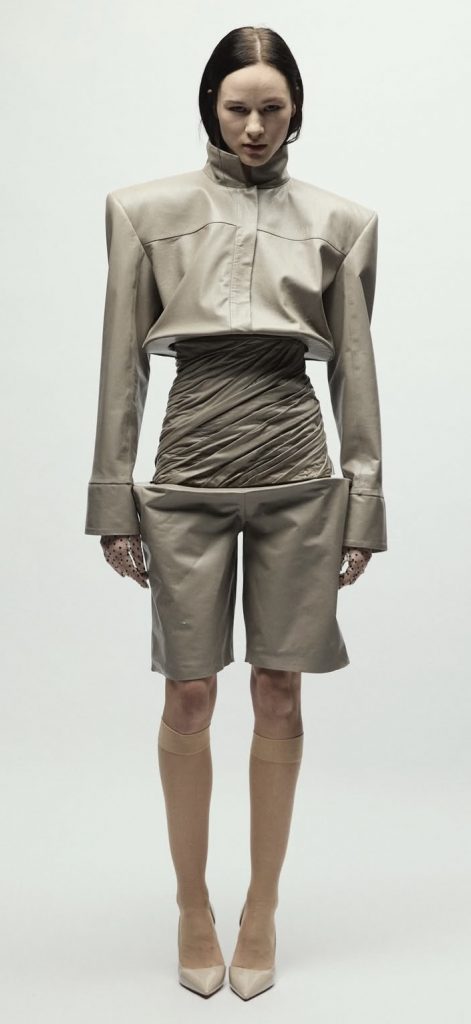
CR: On the one hand, there is total freedom: I was constantly encouraged to explore outlandish ideas, to experiment conceptually, and to unleash my imagination without commercial constraints. The school’s education is deeply experimental; materials, form, and research are treated as tools for exploration, not just for finishing a «pretty» garment. On the other hand, this freedom comes with very real pressure: because you’re given so much leeway to define your own vision, you’re expected to produce something meaningful. The guidance is very personal; the teachers follow you year after year and constantly challenge you to delve deeper and defend your ideas. This tension forced me to grow in ways I didn’t expect: I became more disciplined, more reflective, and more self-assured. I learned to trust my intuition, but also to back it up with solid research and to realistically push my concepts forward.
LM: How did you manage to turn your reflections into something more tangible?
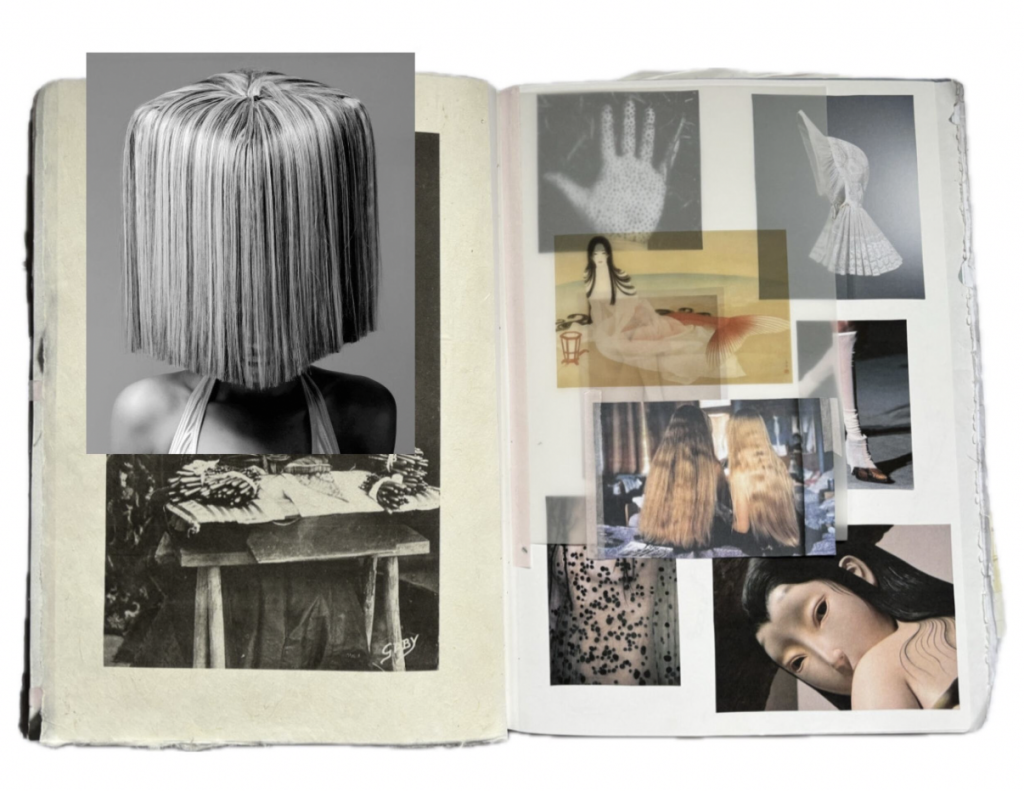
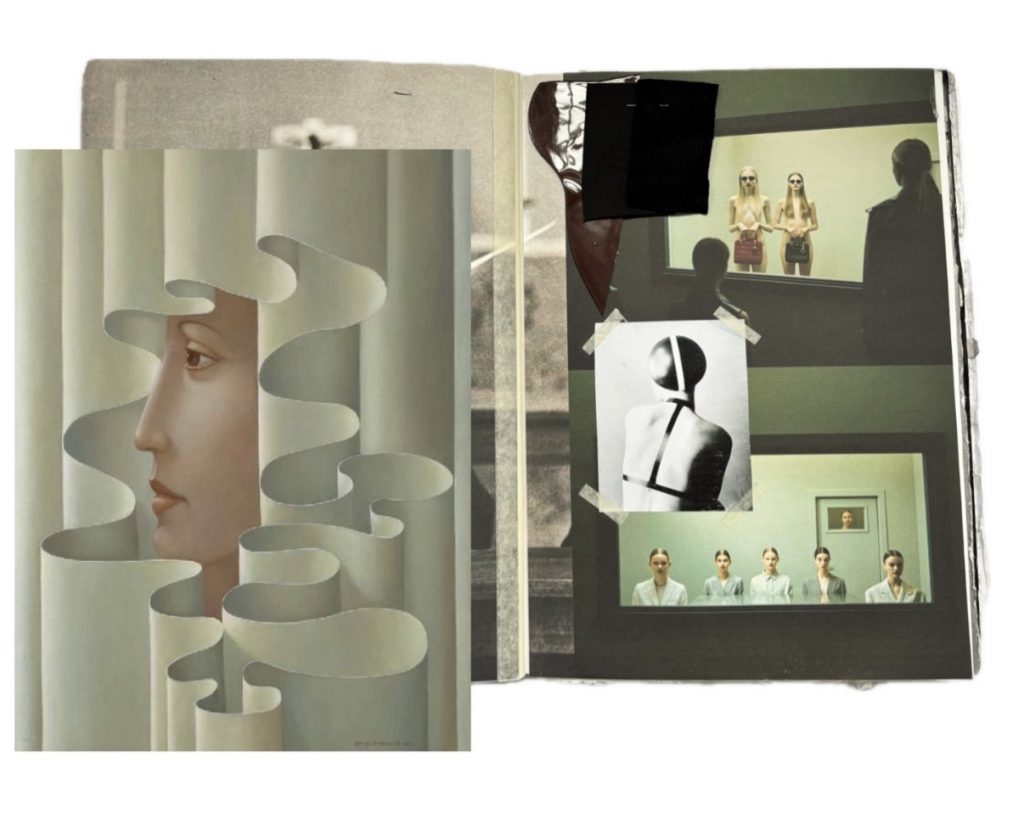
CR: For me, this process always begins with research. I spend hours in the library, browsing books, visiting museums, and studying different artists. That’s how I eventually discovered George Underwood. I found one of her works that I found deeply intriguing, and it became the starting point for my exploration. I usually begin with a key image that captures the essence of what I want to explore, and from there, I expand my research. Once the foundation seems solid, I start sketching in my notebook, where I compile all my research and allow myself to make freer, more intuitive drawings. When a sketch starts to look right on paper, I move into three dimensions. I begin shaping the silhouettes on the mannequin using test fabrics. For more complex shapes, I sometimes construct them on paper first so I can quickly study the proportions and understand the spatial logic before moving to fabric.
LM: Part of your working method involves studying regional or historical costumes to understand their construction, symbolism, and function. What attracts you to the codes of classical or folk dress? Do you see them as opposites or as material for reinvention?
CR: In my second year of undergraduate studies, we were asked to create a historical costume, which was my first real contact with technical sewing. It was a revelatory experience: I learned how patterns really work, how precise they need to be, and how classic garments are made according to clear codes, rules, proportions, and layers worn in a specific order to create the desired silhouette. What attracts me to classic and traditional clothing is precisely that sense of structure and intention. Nothing is arbitrary. Every layer, every seam, every closure has a meaning, whether symbolic, functional, or cultural. These garments reveal a logic that has been perfected over generations, and I find that incredibly inspiring.
LM: Do you think you’ll use the same working method in your future projects?
CR: I think many elements of this working method will continue to play an important role in my future projects, as it fits very well with how I develop ideas. Research, visual stimuli, and experimentation with materials are essential steps for me. They help me stay grounded while still allowing room for intuition. At the same time, I know that each project requires a slightly different approach. I expect my method to grow and change, becoming more refined, more efficient, and more personal as I gain experience. However, the basic structure will remain. I start with in-depth research, build a solid visual and conceptual foundation, sketch freely, and then translate those ideas into three-dimensional forms. This process offers both direction and freedom, and I see it as something I will continue to develop rather than replace.
LM: What does it mean to you to have been recognized as the “Most Promising Graduate of 2025” by the Belgian Fashion Awards?
CR: For me, being recognized as the Most Promising Graduate of 2025 by the Belgian Fashion Awards still feels surreal, and honestly, I’m still savoring the moment. I feel incredibly honored and humbled to receive this recognition, especially surrounded by so many incredibly talented nominees. Being in the same room as designers whose work I admire and seeing two of my favorites, Pieter Muller and Julia Klausner, nominated in other categories made the experience even more meaningful. It felt like a true celebration of creativity and dedication, and I’m so grateful to have been a part of it.
LM: What personal lessons did you learn from the master’s program experience?
CR: During the master’s program, I primarily learned to trust myself and reflect on who I am and what my aesthetic truly represents, and most importantly, to have the courage to fully pursue it. Around December, I completely changed the direction of my collection, taking a very different path from my original plan. It was a bold choice, but one I felt completely connected to, and it turned out to be the best decision I could have made. The master’s year taught me to dare to dream, to embrace risk, and to work tirelessly for what I believe in. It was a period of personal growth, self-discovery, and creative empowerment, which gave me the confidence to trust my instincts and take my ideas further.
LM: Regarding your graduation collection, how did the idea behind «Dot Dot Dot» come about?
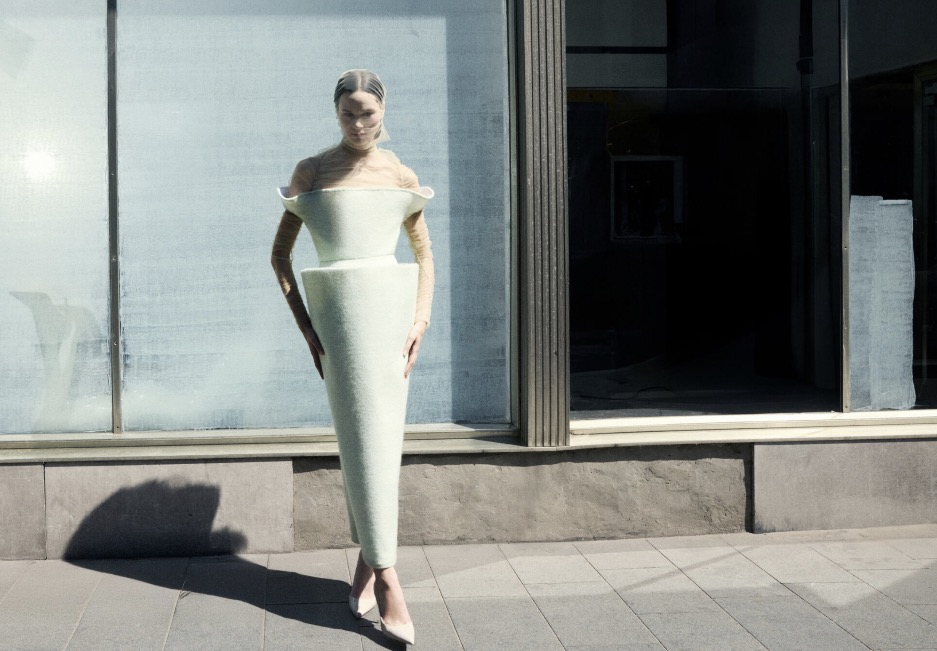
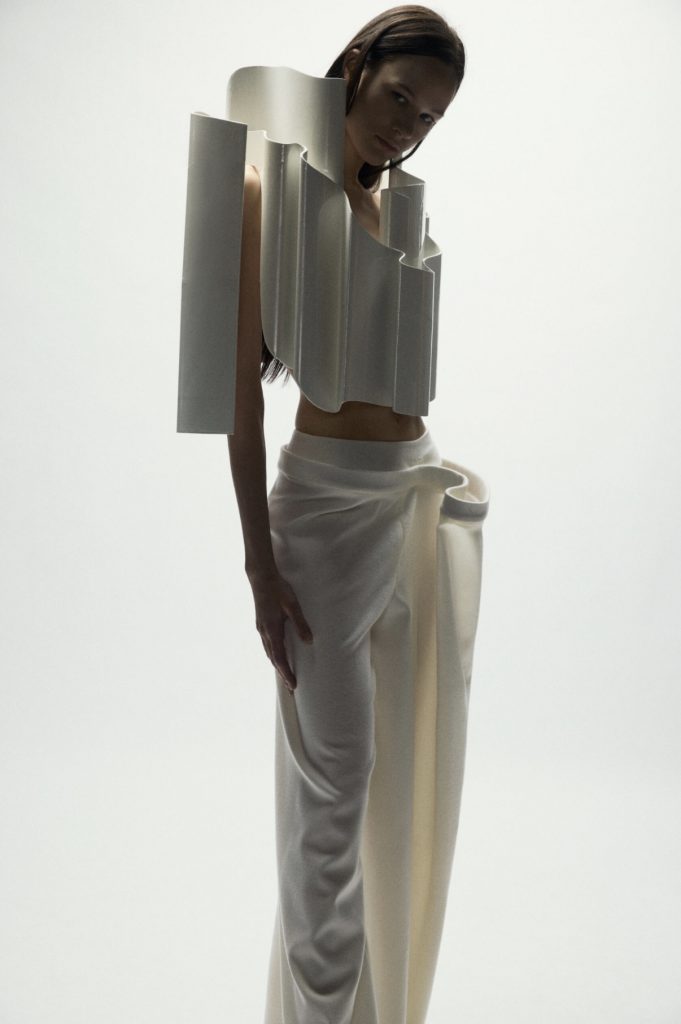
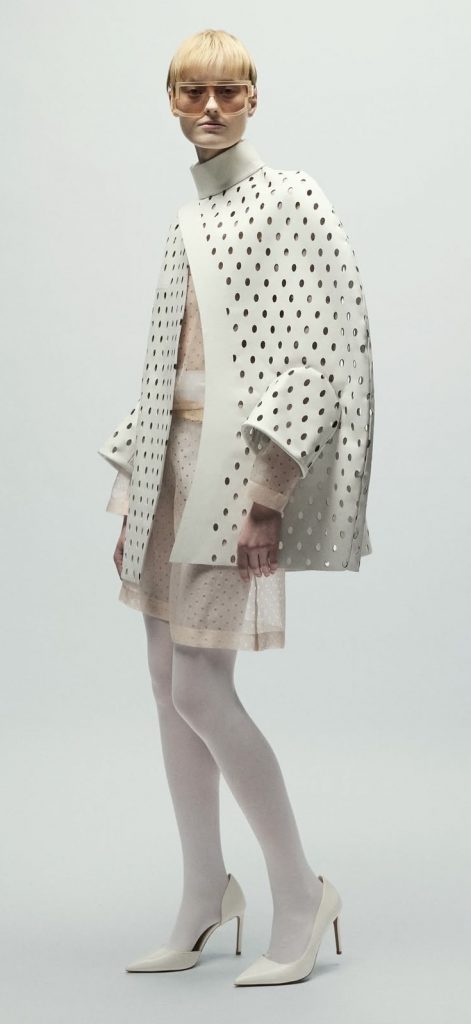
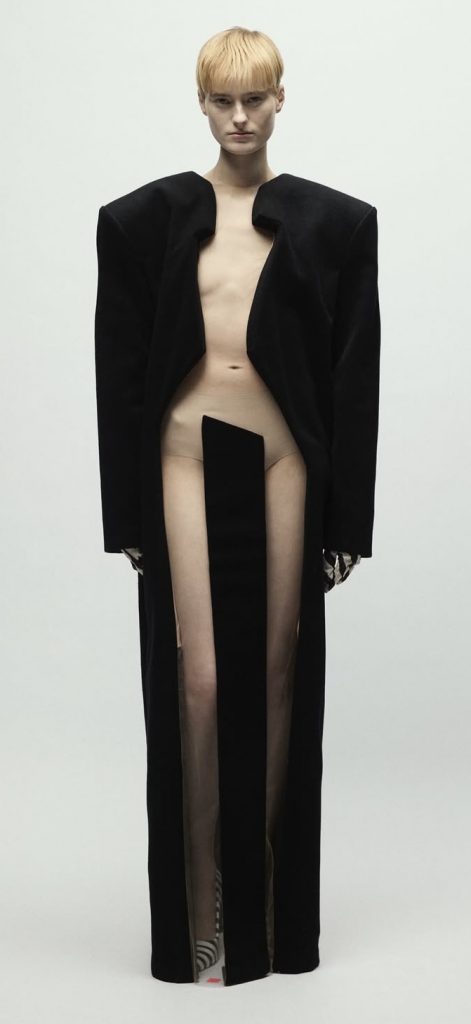
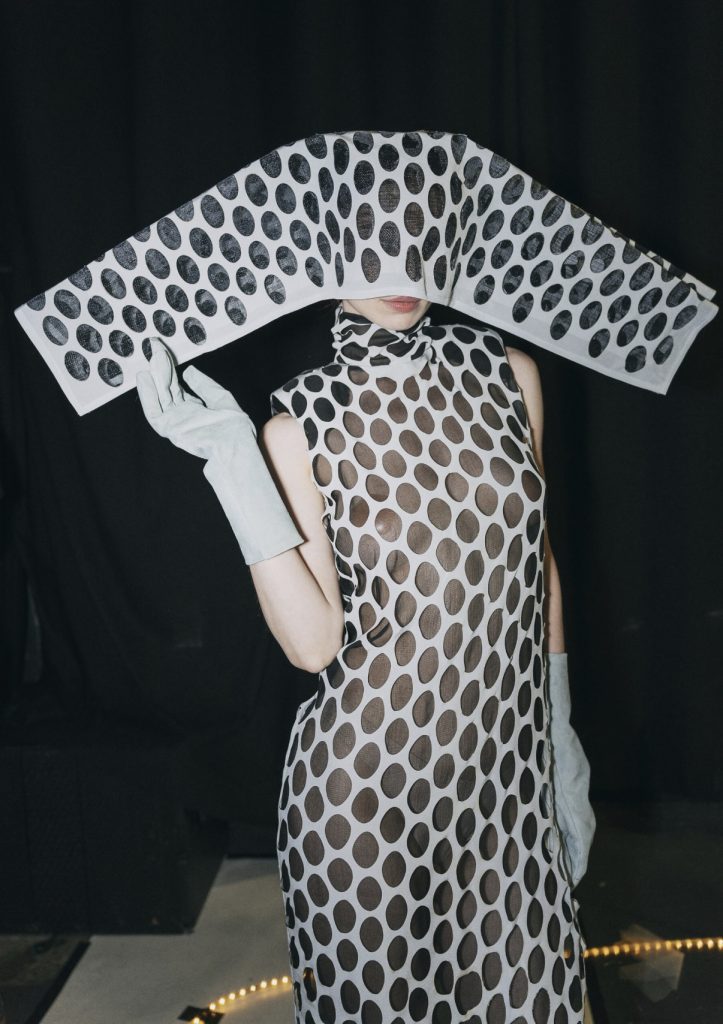
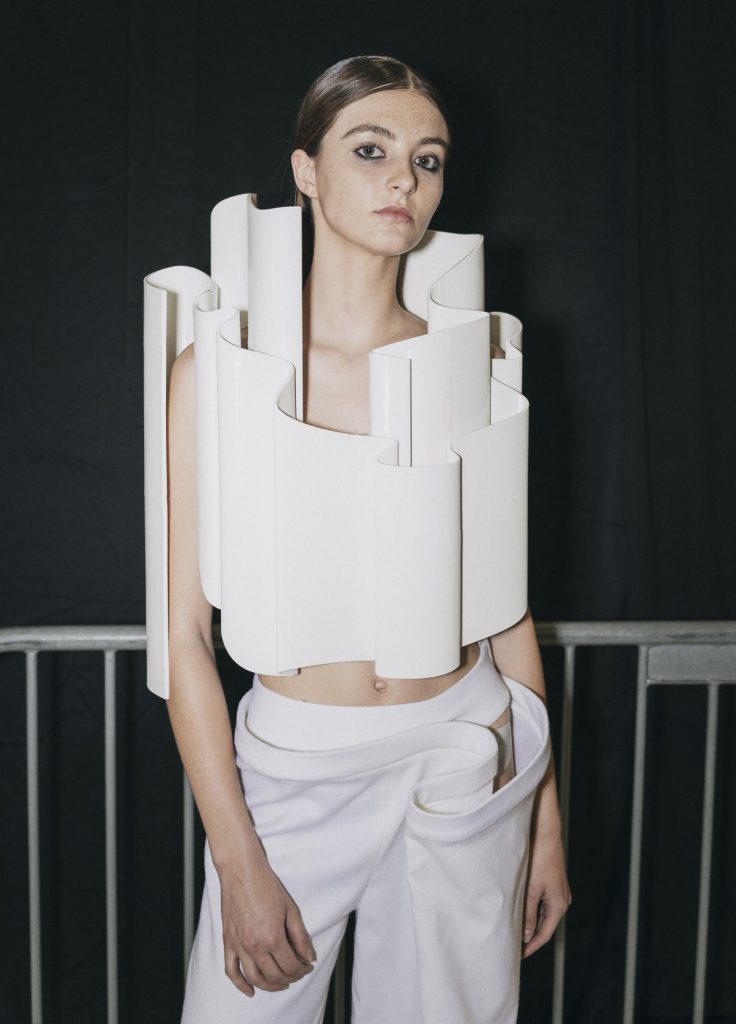
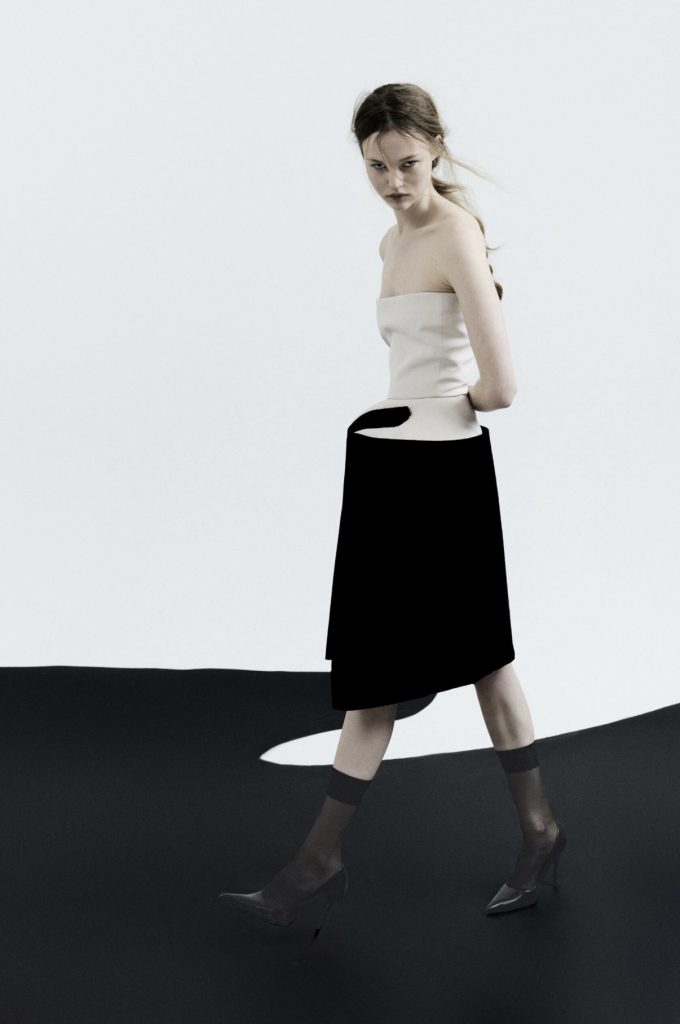
CR: The idea behind “Dot Dot Dot” stemmed from my exploration of the representation of women in Surrealism. I was particularly drawn to how female bodies were often fragmented, objectified, or transformed into something beyond themselves. I found inspiration in the paintings of George Underwood, especially in the way he shows how images and representations can shape our perception of reality. His works often feature faces enveloped in fluid, undulating forms, blurring the line between reality and imagination. This sense of disconnection resonated strongly with my own interest in Surrealist images of women in art and how society constructs idealized images. The figures in these paintings are twisted, elongated, and presented in fantastical and unreal forms. My collection seeks to translate these ideas into fashion through the use of distorted and dreamlike shapes, questioning fixed notions of beauty and identity. Each piece is based on the notion of fragmentation and transformation, encouraging the viewer to reflect on how images, both in art and society, shape our perception of women.
LM: Where does your interest in surrealism come from?
CR: My interest in surrealism comes from the fact that I’m constantly daydreaming. I feel like I’m always floating between reality and my imagination, noticing small details, creating stories, and exploring worlds in my mind. Surrealism fascinates me because it gives form to that in-between space, turning fleeting thoughts and dreams into something visible and tangible. I also love how this art form is always surprising and limitless; there are no rules or boundaries, and anything is possible. It captures the magic of a daydream and brings it into the real world.
LM: What drew you to artists like George Underwood or Giovanni Gasparro?
CR: I’m drawn to artists like George Underwood and Giovanni Gasparro because of the way they transform reality into something dreamlike and thought-provoking. Underwood fascinates me with his use of fluid, surreal forms that blur the line between imagination and reality, while Gasparro’s work captivates me with its attention to detail, emotional depth, and narrative power. Both artists inspire me to explore how visual language can shape perception and evoke feelings. Their work makes me dream and reflect, and there’s plenty of room to play with the elements they create: the shapes, compositions, and details invite experimentation and reinterpretation. They encourage me to experiment with narrative, form, and symbolism in my own work, showing how imagination can shape reality.
LM: What interests you about the distortion of the body or face as a visual resource?
CR: What interests me about distorting the body or face as a visual resource is how it allows me to challenge conventional ideas of beauty and identity. By stretching, twisting, or reimagining forms, I can explore emotions, narrative, and symbolism in ways that realistic representation sometimes doesn’t allow. Distortion opens up a space for imagination and interpretation, inviting viewers to question their assumptions and engage with the work on a deeper, more personal level. It reflects the surreal and dreamlike qualities that appeal to me and allows me to experiment with how form and perception make sense.
LM: How do you interpret the female figure within Surrealism, and how did you want to reinterpret it?
CR: I see the female figure in Surrealism as a space for exploring imagination, fragmentation, and social ideals. In my collection, I reinterpreted it through distorted and dreamlike forms to question conventional beauty and identity.
LM: Do you think your collection seeks to deconstruct the idea of »beauty» or simply to show its complexity?
CR: I think my collection does both. It seeks to deconstruct traditional ideas of beauty through the use of distorted and dreamlike forms that challenge conventional proportions and expectations. At the same time, it aims to show the complexity of beauty, recognizing that it is not fixed or singular, but multifaceted and subjective. By combining surrealism with personal interpretation, the collection invites the viewer to reflect on how beauty is perceived, constructed, and experienced.
LM: How do you think “Dot Dot Dot” has shaped your identity as a designer, and where would you like to evolve from here?
CR: “Dot Dot Dot” has shaped my identity as a designer by teaching me to trust my intuition and fully embrace my aesthetic vision. The collection pushed me to experiment with form, distortion, and surrealism, helping me understand how to translate ideas from concept to three-dimensional reality. It also gave me the confidence to take risks and make bold creative decisions that truly reflect who I am as a designer. Looking ahead, I would like to continue evolving by exploring new materials, techniques, and ways of telling stories, while deepening my engagement with themes such as identity, perception, and transformation. I want to push the boundaries of my practice, creating works that are visually impactful and conceptually meaningful.
LM: On the other hand, how do you think the master’s program helped you build your own identity for your future projects?
CR: I think the master’s program helped me build my own identity because it gives you a lot of freedom in the creative process. You’re encouraged to explore, experiment, and really find your own voice because there’s room to do so. At the same time, the program teaches you to strive for perfection. You don’t consider a look complete until it meets your own standards and fits who you are as a designer. This combination of freedom and rigor helped me understand my aesthetic and strengthened my confidence when making creative decisions for future projects.
LM: After reaffirming your position as a designer within the Belgian industry by winning the «Most Promising Graduate of the Year Award» at the Belgian Fashion Awards, what kind of projects would you like to develop from now on? Do you want to continue working on projects in the same style as those you did during your studies at the Royal Academy of Fine Arts in Antwerp, or do you prefer to innovate and immerse yourself in all kinds of projects?
CR: I think time will tell, but I would accept any project that excites me and sparks my creativity.
Questions by @luuciamer
Translated by @alraco43