
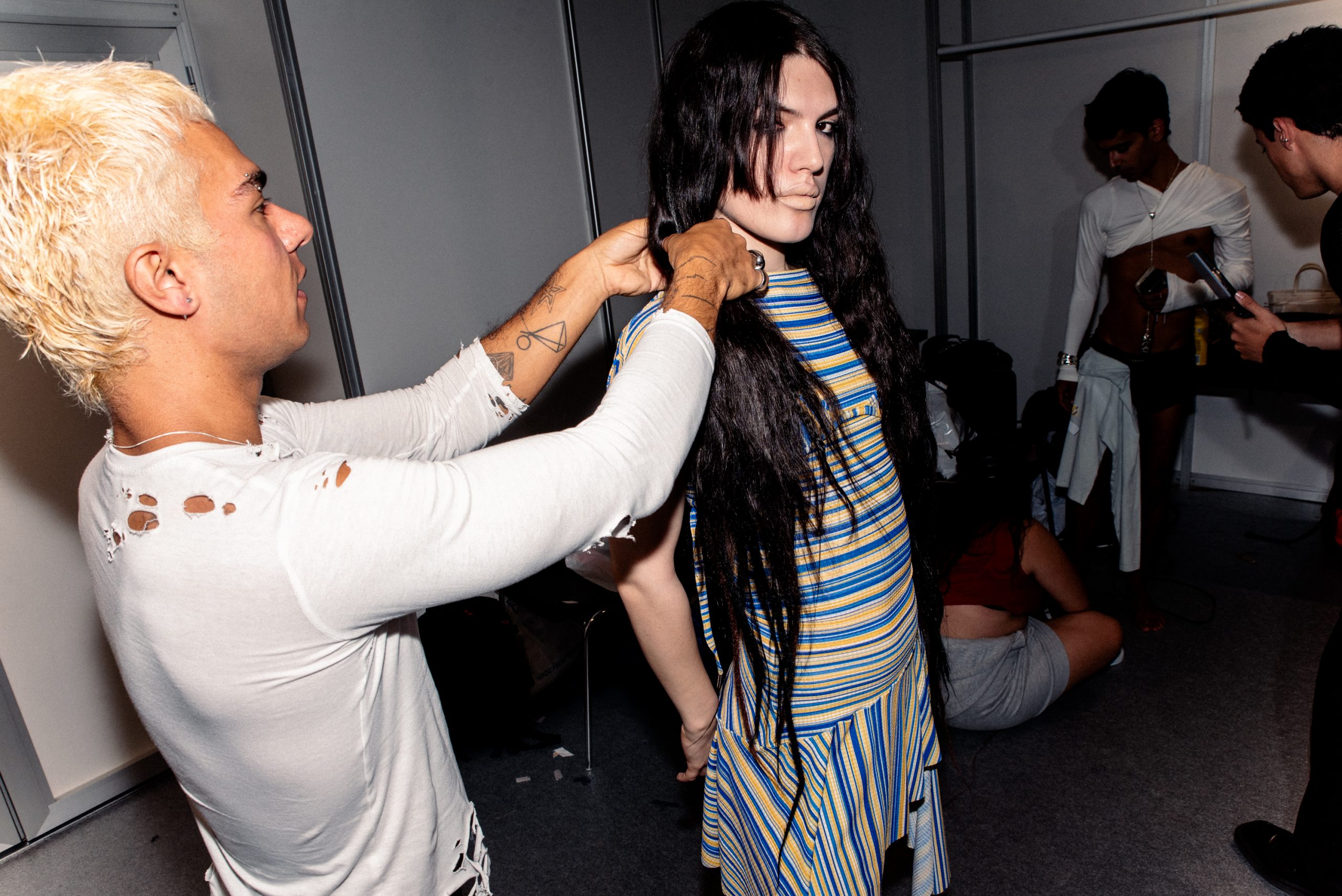
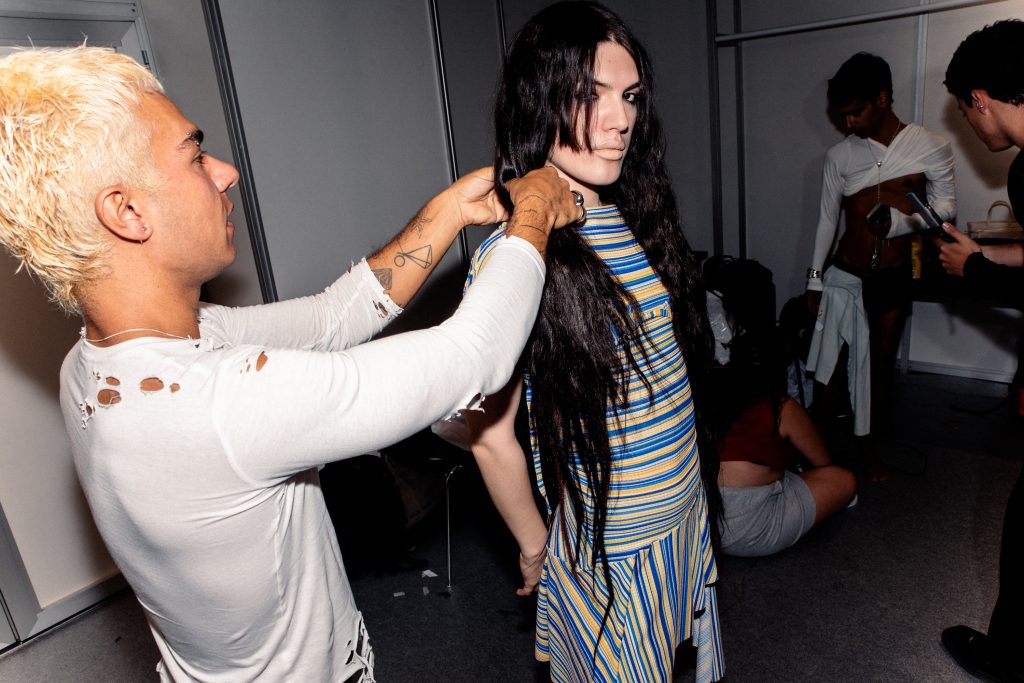
DIMONI STUDIO BY JOAN RIBAS: AN IN-DEPTH INTERVIEW
Some inspirations arrive unexpectedly. Sometimes all it takes is a catchy tune, an ordinary summer, and the boundless imagination of a designer. This is how “Copac4b4na,” the new collection from Dimoni Studio, was born. The project takes Barry Manilow’s iconic 70s song as its starting point, transforming it into a vibrant and nuanced universe of its own. In this interview, its creator, Joan Ribas, opens the doors to his creative process, both for the collection and its recent presentation at Madrid Fashion Week 2025. He lovingly recounts this universe, from the initial inspiration to the technical and conceptual construction of each garment.
Behind its carefree tone and sporty aesthetic, with nods to 2000s streetwear, lies a conscious and contemporary discourse, where fashion becomes a vehicle for political, social, and personal messages. The designer speaks honestly about the challenges of the process, about working with professionals like Chamo Armada who helped him «enhance» the looks in the show, his collaboration with UNODE50, one of the most renowned jewelry brands in Spain, and the excitement of seeing his clothing begin to move beyond the runway.
More than a collection, «Copac4b4na» is an evolution: a step forward toward a more mature and sensual identity, without losing its freshness or urban edge. A story told to the rhythm of music, tailoring, and attitude, because in the world of the brand, every garment has something to say, and every stitch sounds like another note in its own soundtrack.
Each piece from Dimoni Studio is born from the body—from the act of trying, twisting, and transforming a t-shirt until it acquires new life—and this experimental process becomes a way of thinking with one’s hands. There is something profoundly intuitive in his design approach, a constant search between the spontaneous and the calculated, between chaos and precision.
Celia Aldama: Next, we chat with the brand’s creator and designer, Joan Ribas, about his creative universe, his vision of contemporary fashion, and the journey that led him to «Copac4b4na.»
CA: How did you come to the conclusion that the collection’s inspiration should be the Barry Manilow song, so well-known in the 70s and which gives the collection its name, «Copac4b4na»?
JR: It was simply the song I was listening to on repeat all summer. Listening to it so much eventually starts generating ideas, and little by little, you begin to weave concepts together. At first, it’s something innocent, and then it takes shape, and the inspiration becomes more evident.
CA: Regarding the evolution of the collection’s research, did it lead you to be inspired by a specific woman, or had you already decided beforehand?
JR: The woman who somewhat inspires the collection is the showgirl described in the song, the life she leads, and some of what happens to her. It’s not a specific woman, but rather the idea of her.
CA: The looks visually relate to sportiness and that more streetwise style of the 2000s. Would you say you were also inspired by this aesthetic, or is it more of a statement?
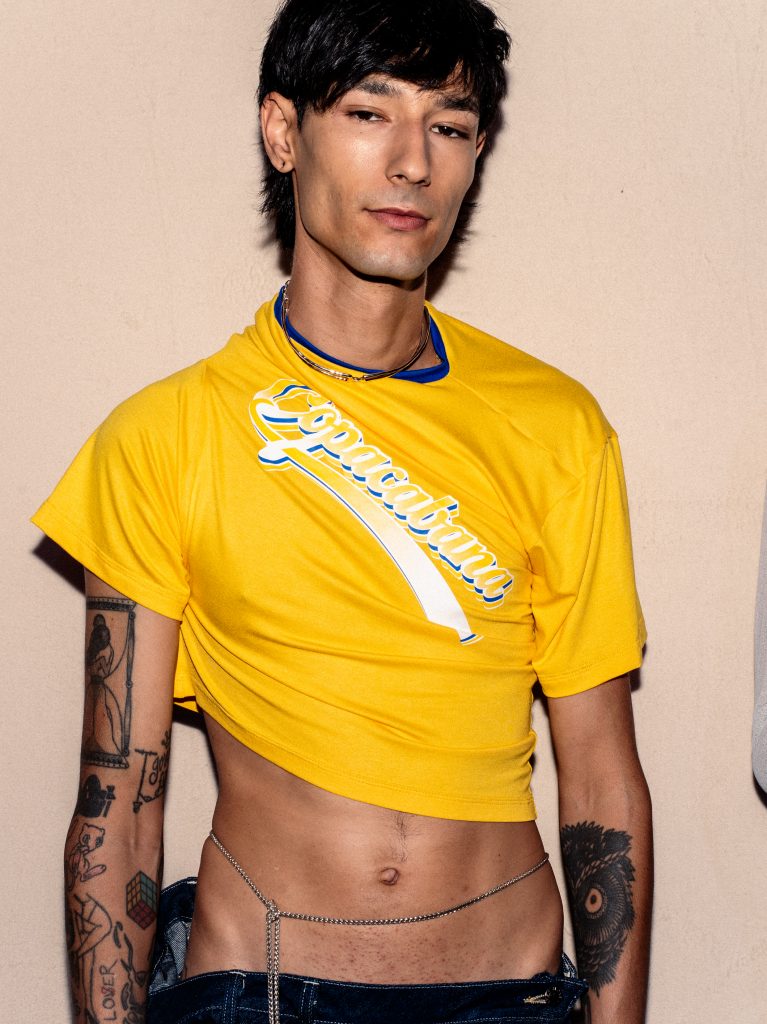
JR: Streetwear style and sportswear codes are always present; both are starting points for the creation of the brand. Part of Dimoni Studio’s DNA is based on reinterpreting the codes of those worlds. References to the 2000s have appeared in some looks, but I think that also depends on the eye of the beholder.
CA: Could there be a political message behind the collection?
JR: There is. Together with Chamo Armada, we worked on a fundamental message through the styling. Taking advantage of the fact that the show fell on the International Day of Peace, we felt it was important to highlight the message, considering the current political climate with the multiple armed conflicts and the rise of the far right. It is essential that designers not only create clothes, but also, through them and the platforms they use, establish relevant discourses that speak to the present.
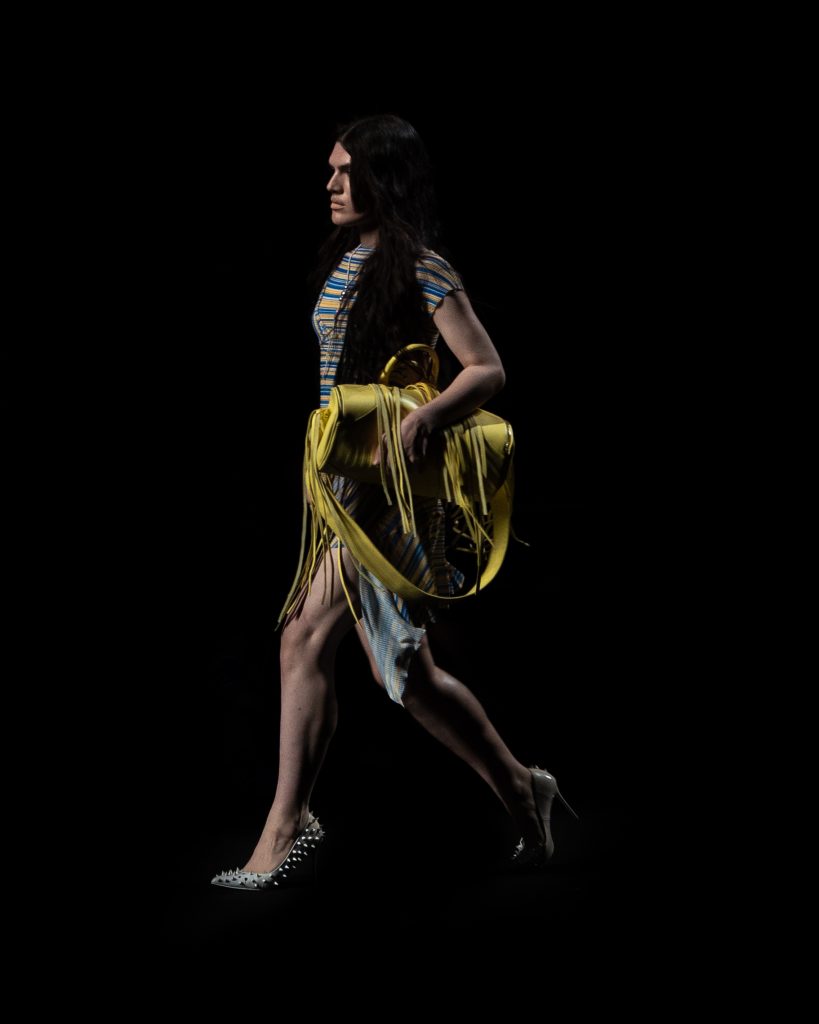
CA: How would you define the collection from your point of view?
JR: A cocktail of ideas, which might not seem like it, but they all work together.
CA: How would you describe the level of difficulty or challenges in the collection’s creation process?
JR: Extremely high, due to the limited time available to work on the collection itself and the time of year. In Spain, it’s customary for almost everyone to be on vacation in August, so it was difficult to tie up loose ends, schedule meetings, contact suppliers, etc.
CA: Regarding the more technical aspects, the garment patterns are complex, yet versatile and adapt very well to the silhouette. Did you leave this more technical process in the hands of pattern makers, or were you personally involved with them in every detail of the creation process?
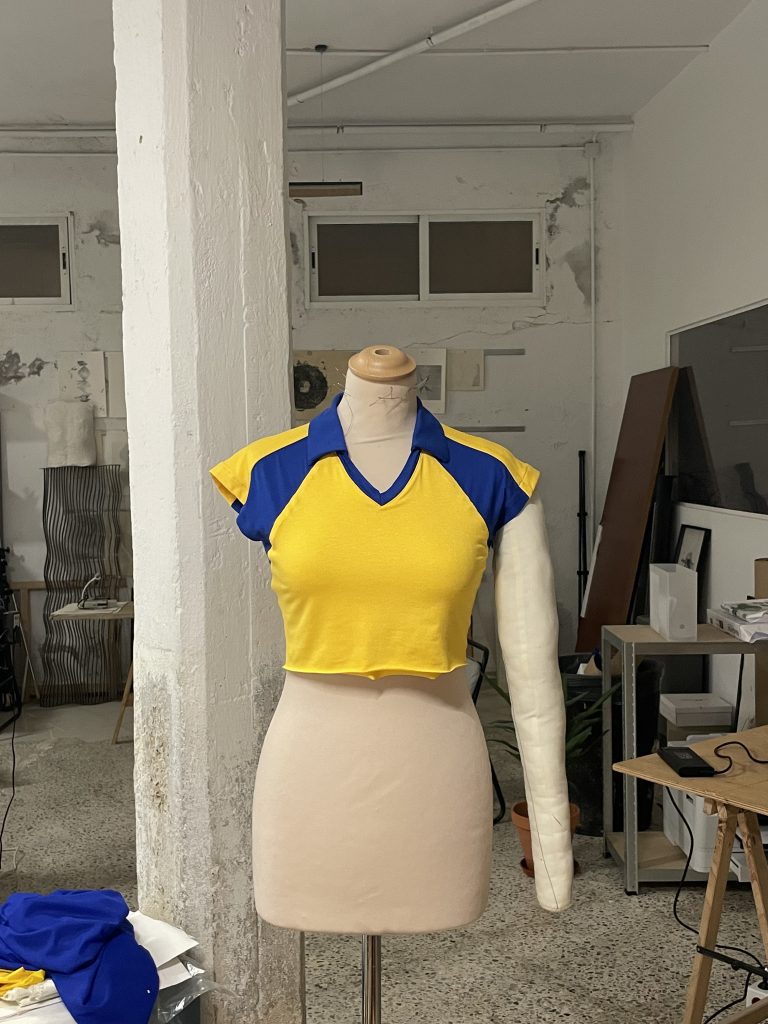
JR: I almost always try to make all the patterns myself. Often, the creation process for these garments starts with things I try on at home, with clothes I already have in my closet. With the number of knots, twists, and turns involved, it’s very difficult to explain it to someone else. Although it’s true that for more «basic» or standardized garments, I do turn to my trusted pattern makers, since they have more knowledge and experience than I do.
CA: How would you describe this pattern-making and garment-making process for the collection?
JR: The ideas for the garments often come from how people wear clothes in real life, but the pattern-making process is pure experimentation. The vast majority of the garments I design stem from my own experimentation, both on my own body and on a mannequin. My phone’s gallery is full of videos and photos of me trying on T-shirts with a thousand holes, trying different ways to twist them, to find new drapes or shapes.
CA: What does this collection mean to you?
JR: This collection represents an evolution, a revision of the streetwear/gym starting point I established in the first show. A new path towards something a bit more personal with a sexier twist.
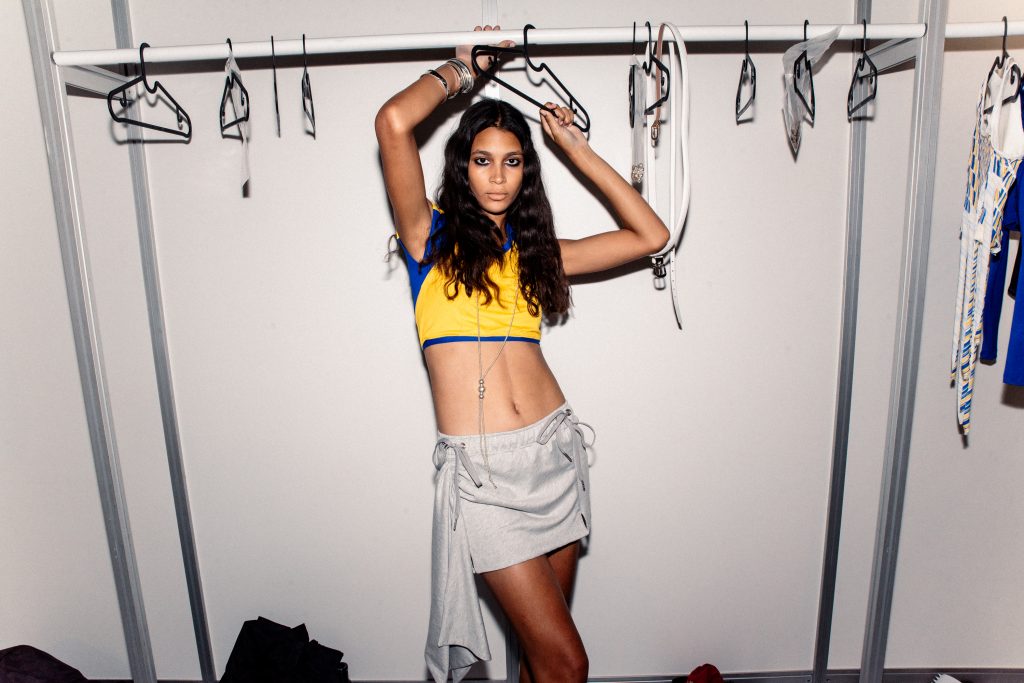
CA: Have you collaborated with stylists or other industry specialists to combine different looks or accessories?
JR: I’m someone who immediately thinks about complete looks. I have a pretty global vision of how I want the garment to look, how it should be styled, and how I think it should be conveyed. But it’s true that I try to get external perspectives to support and reinforce that vision. In this case, as I mentioned before, I collaborated with Chamo Armada, who helped me enhance the styling of the collection and elevate the clothing to a whole new level.
CA: Have you made any last-minute changes that you thought would be a disaster but turned out to be the complete opposite?
JR: Several, but it’s best not to talk about them. What goes wrong should only be known from the inside, haha.
CA: Do you see a before and after in the «Copac4b4na» collection, from the initial concept to the final result?
JR: The styling went through many phases and changes, and I think that’s what has brought about the biggest change in terms of the initial vision.
CA: Do you think this collection will change your career for the better?
JR: I think it will help in terms of exposure, and we’ll see what the consequences are. Ultimately, the idea is to gradually grow and create new projects to further establish the brand.
CA: These days, with all the buzz surrounding the fashion show, what message or congratulation has made you happiest?
JR: Any of them. Honestly, what makes me happiest isn’t a congratulation per se, but rather that people want to use the clothes for editorials, music videos, and various projects. That the clothes are really taking off.
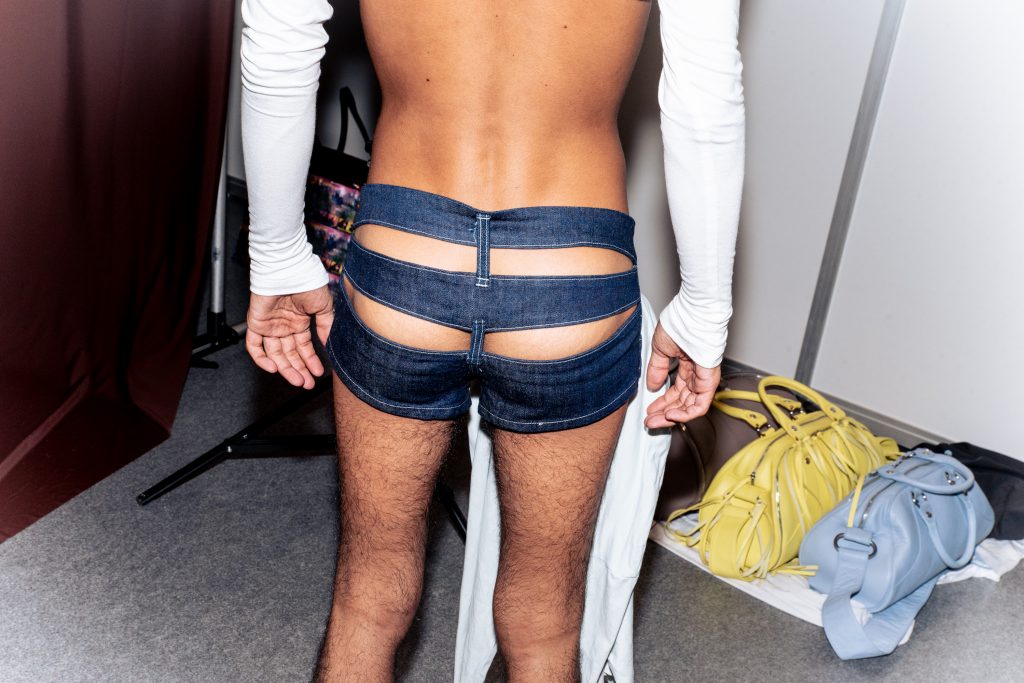
CA: Regarding the staging, is the song from the EGO fashion show that accompanies the collection symbolic, or is it simply there to complement it?
JR: The song for the show was created solely and exclusively for that purpose. We were working with David Alcubilla (@iamdaybeat) on a track that would reflect the essence of the runway and the styling, while also having certain nods to the first track we made for the 2024 show. We wanted it to feel like an evolution or continuation of that.
CA: What does Dimoni Studio mean, and how do you think it influences the national fashion scene?
JR: Hmm, I don’t really know how to answer that. I don’t really perceive how my work might influence things, to be honest. I just do my thing and see what happens.
CA: How many years have you been running the brand? And why did you decide to share your creations with the industry?
JR: I haven’t been running it for very long. Although I founded the brand as my master’s thesis project in 2022, the first official collection was the one I presented in February 2024. I was creating things on my own, and at that time I believed that what I was doing had good potential, so I went all in.
CA: Have you always been sure that you wanted to go into fashion?
JR: No, haha. Until the end of my second year of high school, I was very clear that I wanted to be a veterinarian. But at the last minute, when I had to register for the university entrance exams, I decided to tell my parents about this crazy idea. And they supported me 100%.
CA: Throughout your career, have you been influenced by art or specific movements as a source of inspiration for your creations?
JR: I’m not sure. I think I pay much more attention to things I see every day on the street. I consider myself a very observant person, and I’m always watching people on the street. Even if there’s a song, a film, or a work of art that serves as «inspiration» for the collection, like in the case of «Cop4Cab4ana,» it’s more of a link to bring the garments together and create the collection as such.
CA: From your perspective, how do you see going from being an «anonymous» emerging designer to being seen as one of the most promising emerging designers in national and international fashion?
JR: If that’s true, thanks, haha. I’m really happy that people want to know more and want to see more of my designs. At the end of the day, we all want our work to be valued and for people to want to wear our clothes. We don’t just want to create fashion for the sake of it; we also want those garments to have staying power and be desirable to everyday people.
CA: How did your first collaboration with a renowned artist come about, and how did you feel about them wearing your creations?
JR: My first collaboration with an artist was with Julieta, and I was truly thrilled that an artist I consider to have so much potential wanted me to be part of one of her tours. At first, it was a little difficult to find the right balance, since show pieces have certain characteristics they need to meet to look their best (a fashion show or a photoshoot isn’t the same as a concert), but in the end, we managed to create some incredible looks.
CA: In the Copac4ban4 collection, you collaborated with Unod50. How did this partnership and fusion of brands come about?
JR: It was a very organic proposal for several reasons. We were very clear that we wanted only silver in our jewelry for the show, and Unod50’s involvement was the perfect match. They gave us access to a large archive of pieces, allowed us to visit their offices, and it was a pleasure working so closely with them.
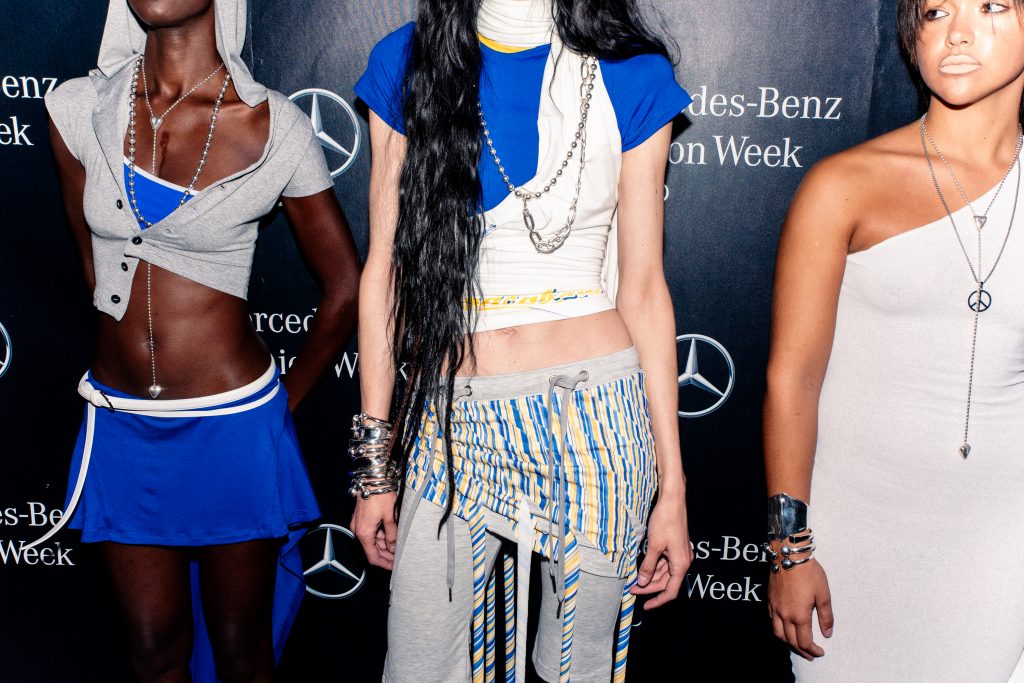
CA: And how did you carry out the creative process of both brands merging styles (jewelry and fashion) for the collection, ensuring that both were happy and satisfied with the result?
JR: It’s largely based on understanding the vision and values of the other brand to see from the outset if they align. Once you believe the union makes sense for both brands, it’s simply a brainstorming session of ideas until you feel everything fits together and strengthens the collaboration.
CA: What do you think this collection can contribute to Spanish or European society?
JR: A bit of fun, a twist on commercial garments like a t-shirt or jeans, making them more interesting and different.
CA: And how would you define in three words, or how do you imagine, the prototype of the person who will wear the looks from the collection in real life, beyond the catwalk?
JR: Sexy, charismatic, and experimental.
Questions by @celialdamag
Translated by @alraco43